
Finding the right health insurance when you work for yourself can feel overwhelming. For many in the Hispanic community, language barriers, unfamiliarity with the system, and the cost of coverage add another layer of difficulty. That is why self employed Hispanic ACA leads have become such an important category in the health insurance marketplace. These leads connect agents and insurance providers with individuals who are actively looking for coverage under the Affordable Care Act but need guidance in their own language and cultural context.
This guide breaks down everything you need to know about self employed Hispanic ACA leads, including what they are, why they matter, how to qualify, and how agents can use them effectively.
What Are Self Employed Hispanic ACA Leads?
In simple terms, self employed Hispanic ACA leads refer to prospective health insurance clients who identify as Hispanic, are self-employed, and are actively seeking coverage through the Affordable Care Act marketplace. These individuals may be gig workers, food truck operators, landscapers, nail technicians, construction subcontractors, house cleaners, or any other type of independent worker who does not have employer-sponsored health insurance.
For insurance agents, self employed Hispanic ACA leads are highly valuable because this demographic is one of the largest underinsured groups in the United States. Many Hispanic individuals who are self-employed either do not know they qualify for subsidized ACA plans or they have never been approached in a way that felt accessible or trustworthy. This is exactly why targeted outreach matters.
Why the Hispanic Self-Employed Community Needs ACA Coverage
The Hispanic workforce in America is deeply entrepreneurial. According to various reports, Hispanic-owned businesses are among the fastest-growing segments in the U.S. economy. But with that independence comes the challenge of securing benefits that employees at larger companies take for granted.
Self employed Hispanic ACA leads often come from communities where people have historically avoided or delayed healthcare due to cost concerns. Many are unfamiliar with how premium tax credits work or how the income verification process for ACA enrollment functions. This is a gap that agents who specialize in this space are uniquely positioned to fill.
Common Barriers Faced by Hispanic Self-Employed Workers
- Language barriers when navigating the healthcare.gov portal
- Mistrust of government programs due to immigration-related concerns
- Irregular income that makes it hard to estimate annual earnings for subsidies
- Lack of awareness about available financial assistance
- Cultural preference for community referrals over cold outreach
Understanding these barriers is key for any agent working with self employed Hispanic ACA leads. Empathy, clarity, and language access go a long way in building trust with this population.
How the ACA Works for Self-Employed Individuals
The Affordable Care Act was designed with self-employed individuals in mind. If you work for yourself and do not have access to employer-sponsored insurance, you are eligible to shop for coverage through the ACA marketplace. Depending on your income level, you may qualify for significant subsidies that bring your monthly premiums down to a manageable level.
Self employed Hispanic ACA leads typically fall into households that earn between 100% and 400% of the federal poverty level, which is the range where premium tax credits kick in most significantly. In recent years, the enhanced subsidies introduced through the American Rescue Plan and the Inflation Reduction Act have extended financial assistance even further up the income scale, making coverage more affordable than ever.
Key ACA Benefits for Self-Employed Workers
- No denial of coverage based on pre-existing conditions
- Premium tax credits based on household income
- Cost-sharing reductions for lower-income individuals
- Coverage for essential health benefits including preventive care, mental health, and prescriptions
- Open enrollment periods with special enrollment options for qualifying life events
Why Agents Should Prioritize Self Employed Hispanic ACA Leads
For health insurance agents, self employed Hispanic ACA leads represent one of the most consistent and growing segments of the ACA-eligible population. The combination of high uninsured rates, increasing self-employment, and expanded subsidy availability makes this a prime opportunity for agents who are willing to invest in culturally competent outreach.
Self employed Hispanic ACA leads convert at strong rates when agents approach them correctly. This means communicating in Spanish when needed, understanding the nuances of irregular income, and being able to explain the subsidy structure in plain language without making clients feel like they are being talked down to.
What Makes a High-Quality Lead in This Space?
Not all self employed Hispanic ACA leads are created equal. High-quality leads in this category share a few important traits:
- The individual has confirmed they are self-employed with no access to job-based insurance
- They have expressed genuine interest in ACA coverage
- Income falls within a range that qualifies for subsidies
- They are a U.S. citizen or lawfully present immigrant
- They are reachable by phone, text, or in-person appointment
When agents invest in verified self employed Hispanic ACA leads, they reduce time spent on dead-end calls and increase their close rates significantly. The key is working with lead providers who understand this specific demographic and can deliver contacts that are both accurate and pre-qualified.
How to Connect with Self Employed Hispanic ACA Leads Effectively
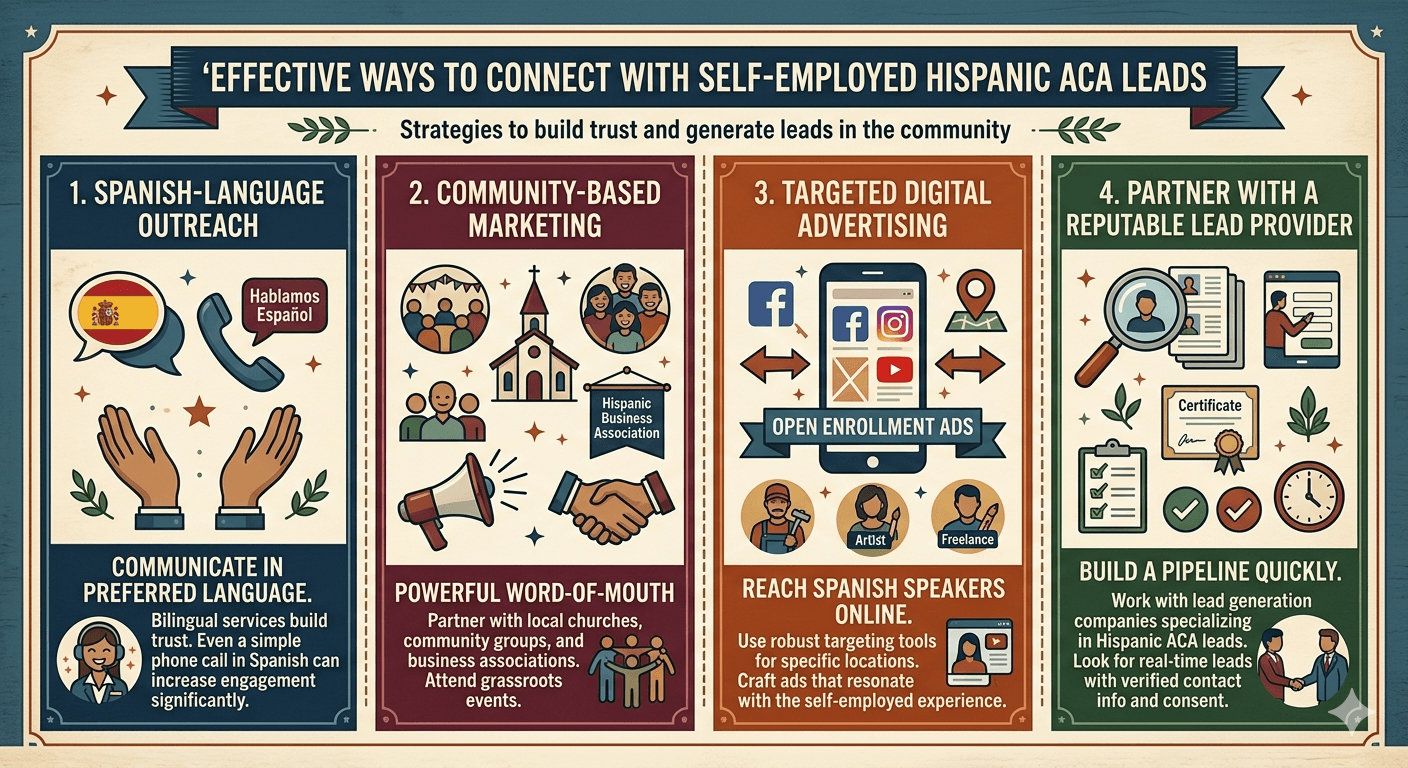
Reaching self employed Hispanic ACA leads requires a different strategy than general ACA marketing. Here are some approaches that consistently work well in this community:
- 1. Spanish-Language Outreach: A significant portion of self employed Hispanic ACA leads prefer to communicate in Spanish, especially when discussing complex topics like health insurance. Agents who offer bilingual service or who partner with Spanish-speaking navigators have a clear advantage. Even a simple phone call in Spanish can dramatically increase trust and engagement.
- 2. Community-Based Marketing: Word of mouth is powerful in Hispanic communities. Agents who build relationships with local churches, community organizations, Hispanic business associations, and social media groups tend to generate a steady stream of referrals. This type of grassroots approach is a natural complement to purchased self employed Hispanic ACA leads.
- 3. Digital Advertising Targeted to Spanish Speakers: Facebook, Instagram, and YouTube all offer robust targeting tools that allow agents to reach Spanish-speaking users in specific geographic areas. Running ads during open enrollment periods that speak directly to the self-employed experience can be a highly effective way to generate fresh self employed Hispanic ACA leads in real time.
- 4. Partnering with a Reputable Lead Provider: One of the fastest ways to build a pipeline is to work with a lead generation company that specializes in self employed Hispanic ACA leads. These providers use online forms, call centers, and digital campaigns to identify and pre-qualify prospects before passing them to agents. Look for providers that offer real-time leads with verified contact information and consent documentation.
Understanding ACA Income Rules for Self-Employed Applicants
One of the most common issues that comes up with self employed Hispanic ACA leads is income verification. Unlike salaried employees, self-employed individuals often have variable income that changes month to month. This can make it tricky to estimate annual income accurately for the purposes of calculating subsidy eligibility.
The ACA uses modified adjusted gross income (MAGI) to determine subsidy amounts. For self-employed individuals, this typically means total business income minus allowable deductions. Agents working with self employed Hispanic ACA leads need to be comfortable walking clients through this process and helping them arrive at a reasonable income estimate.
It is also important to let clients know that if their actual income turns out to be higher or lower than what they estimated, there is a reconciliation process at tax time. Being upfront about this builds credibility and reduces the risk of unpleasant surprises later on.
Helping Self Employed Hispanic ACA Leads Plan for Income Swings
Many clients earn more in busy seasons and far less in slow ones. A landscaper may do most of their work in summer, while a house cleaner may see steady months and sudden gaps. Helping them plan for these swings protects both their coverage and their budget.
Start with a simple income worksheet. Ask them to list typical monthly earnings for the past year, subtract basic business expenses, and project the next twelve months. Round estimates thoughtfully rather than guessing high or low.
Explain the risk on both sides. An estimate that is too low may mean repaying part of the subsidy at tax time, while one that is too high can mean paying more each month than necessary. Neither outcome is a disaster when clients understand it in advance.
Encourage regular check-ins. Remind them to update the marketplace if a big contract ends, a new job begins, or earnings change meaningfully. A quick message in Spanish every few months keeps their information current.
Finally, suggest keeping invoices and receipts in one place. Good records make renewals easier and reduce stress. Agents who offer this practical support turn self employed Hispanic ACA leads into clients who feel prepared, stay enrolled, and recommend you to other business owners.
Essential Documents Self-Employed Hispanic ACA Applicants Should Prepare
Qualifying self employed Hispanic ACA leads is only part of the process. Once eligibility has been confirmed, the next step is preparing clients for a smooth enrollment experience. Many self-employed individuals have never purchased health insurance through the ACA marketplace before, so they often feel uncertain about the paperwork, the terminology, and the steps involved. Taking a few extra minutes upfront reduces stress on both sides and reflects well on you as an agent.
- Help clients gather information early. Encourage them to have identification documents, household information, estimated annual self-employment income, recent tax returns or profit-and-loss records, and details about anyone else joining the policy ready before the appointment. Many self employed Hispanic ACA leads run small businesses without organized financial records, so a simple bilingual checklist can save considerable time and reduce the chance of missing information that could delay their eligibility review.
- Know which documents matter most. The key items generally include a government-issued photo ID, Social Security numbers or eligible immigration documents for every applicant, proof of residence, and income records that reflect the applicant’s current financial situation. Depending on the business, this may include bank statements, invoices, 1099 forms, bookkeeping records, or a recent profit and loss statement. Having these ready in advance speeds up eligibility verification and cuts down on follow-up requests that can stall the process.
- Explain the process in simple language. Rather than assuming clients understand how the marketplace works, walk them through each stage. Cover how household information is reviewed, how subsidy eligibility is calculated, how plans are compared, and how monthly premiums are determined. Avoid heavy insurance jargon whenever possible. Self employed Hispanic ACA leads feel far more confident when they understand why certain questions are asked and how their answers shape the plans available to them.
- Build trust through education. Clients who understand the reasoning behind each step are more likely to complete enrollment instead of dropping off midway. Taking the time to explain rather than rush is often what separates a completed application from an abandoned one, and it builds a foundation of trust that carries into future renewals.
- Stay in touch after enrollment. Confirm that the application went through successfully, remind clients about their first premium payment if required, and answer any questions about using their new coverage. A quick follow-up call or bilingual text message shows that your commitment goes beyond the sale and helps prevent confusion once coverage begins.
- Turn support into referrals. This ongoing follow-through transforms self employed Hispanic ACA leads into long-term clients who renew coverage each year, recommend your services to fellow business owners, and become a steady source of referrals within the Hispanic self-employed community.
Open Enrollment and Special Enrollment Periods
Timing matters when reaching self employed Hispanic ACA leads. The standard ACA open enrollment period typically runs from November 1 through January 15, though dates can vary by state. Agents should begin warming up their pipeline well before open enrollment starts so that when the window opens, they are ready to close.
Outside of open enrollment, self employed Hispanic ACA leads can still enroll if they experience a qualifying life event such as losing other coverage, getting married, having a child, or moving to a new state. Agents who stay in touch with their leads year-round are well positioned to capture these special enrollment opportunities.
Building Long-Term Relationships with Hispanic ACA Clients
The real value of working with self employed Hispanic ACA leads is not just the initial enrollment. It is the long-term relationship that follows. Hispanic clients who feel respected and well-served become loyal customers who renew their coverage year after year and refer friends and family members.
Agents should plan for annual check-ins around renewal time, proactive outreach when new plan options become available, and ongoing communication through channels clients prefer, whether that is text messages, phone calls, or social media. Building a reputation in the Hispanic self-employed community takes time, but it pays dividends for years.
Frequently Asked Questions
Q1: Can self-employed Hispanic individuals qualify for ACA subsidies?
A1. Yes! If your income falls between 100% and 400% of the federal poverty level, you likely qualify for premium tax credits. Recent legislation has expanded eligibility even further, so it is worth checking even if you think you earn too much.
Q2: What documents do I need to enroll in an ACA plan as a self-employed person?
A2. You will typically need proof of identity, your Social Security number or immigration status documentation, an estimate of your annual income, and information about any other household members you want to cover.
Q3: Are ACA plans available in Spanish?
A3. Yes. Healthcare.gov has a full Spanish-language version, and many insurance agents offer bilingual support to help Spanish-speaking clients choose and enroll in the right plan.
Q4: What if my income changes throughout the year?
A4. That is normal for self-employed workers. Just report changes to the marketplace as they happen so your subsidy stays accurate. At tax time, any differences are reconciled through your federal tax return.
Q5: How do I find an agent who specializes in working with Hispanic self-employed individuals?
A5. Ask in your local community, check Hispanic business associations, or search healthcare.gov for certified agents and navigators in your area. Look for someone who speaks Spanish and has experience with self-employment income situations.
Conclusion
Health coverage is not a luxury. It is a necessity, especially for self-employed individuals who bear the full weight of managing their own benefits. For agents and providers, self employed Hispanic ACA leads represent one of the most meaningful and commercially rewarding opportunities in the current marketplace. For individuals in the Hispanic community who work for themselves, the ACA offers real, affordable options that many do not yet know exist.
Whether you are an insurance agent looking to grow your book of business or a self-employed Hispanic individual trying to figure out your health coverage options, the message is the same: the resources are available, the help is out there, and you do not have to navigate this system alone. Start exploring your options today, ask questions, and do not settle for being uninsured when coverage may be more affordable than you think.
