
Generating ACA (Affordable Care Act) leads is a big part of growing your insurance business. But here’s the thing getting leads is just half the battle. The other half, which is often overlooked, is doing it the right way through proper ACA lead generation compliance. Following these compliance rules isn’t just about avoiding penalties it helps protect your clients, your reputation, and your business in the long run.
In this guide, we’ll break down what ACA lead generation compliance really means, why it matters, how to stay compliant, and the pros and cons every insurance agent should be aware of.
What Does ACA Lead Generation Compliance Mean?
Simply put, ACA lead generation compliance is all about following the rules when collecting, managing, and using ACA leads. These rules exist to protect sensitive client information and make sure you’re marketing ethically.
Compliance covers everything from:
- How you collect leads (forms, calls, social media, etc.)
- How you store and protect their information
- How you reach out to them without being misleading or aggressive
Not following these rules can land you in serious trouble fines, penalties, or even losing your ability to sell ACA plans.
Why Compliance Matters More Than Ever in 2026
Several developments have made compliance a top priority heading into 2026. CMS finalized new rules that restrict how third-party marketing organizations (TPMOs) can present plan options, require specific disclaimers in all advertising, and mandate prior consent before an agent can discuss a specific plan with a consumer. The FCC’s one-to-one consent rule, which took effect in early 2025, fundamentally changed how lead aggregators can sell and share consumer data. A single lead can no longer be sold to multiple buyers under the old blanket consent model. Compliance now requires a direct, clear, and documented relationship between the consumer and the specific entity contacting them.
Failure to observe compliance exposes agents to administrative actions from their state insurance department, potential federal enforcement, and civil liability under the Telephone Consumer Protection Act (TCPA). The financial and reputational risks are severe. Building your lead generation system around compliance from the start is far smarter and cheaper than correcting violations after the fact.
Key Things to Know About Compliance
To stay compliant, insurance agents need to understand several critical areas:
1. Get Consent and Be Transparent
Always make sure your leads know exactly how you’ll use their information. Tell them who will contact them, what kind of services you offer, and how their data will be handled.
2. Protect Client Data
ACA leads often include sensitive info, like health status and income. Keep it safe. Use secure systems, encrypt electronic data, and never share it with unauthorized parties.
3. Market Honestly
Don’t exaggerate benefits or make false claims. Be clear, truthful, and upfront in every email, call, or ad you send out.
4. Follow CMS Guidelines
The Centers for Medicare & Medicaid Services (CMS) has strict rules on ACA marketing. That includes proper disclaimers, consent before calling, and safe lead transfer if working with other agents.
5. Know Your Lead Sources
Whether leads come from your website, referrals, social media, or purchased lists, make sure the source is compliant. Non-compliant leads can create serious legal risks.
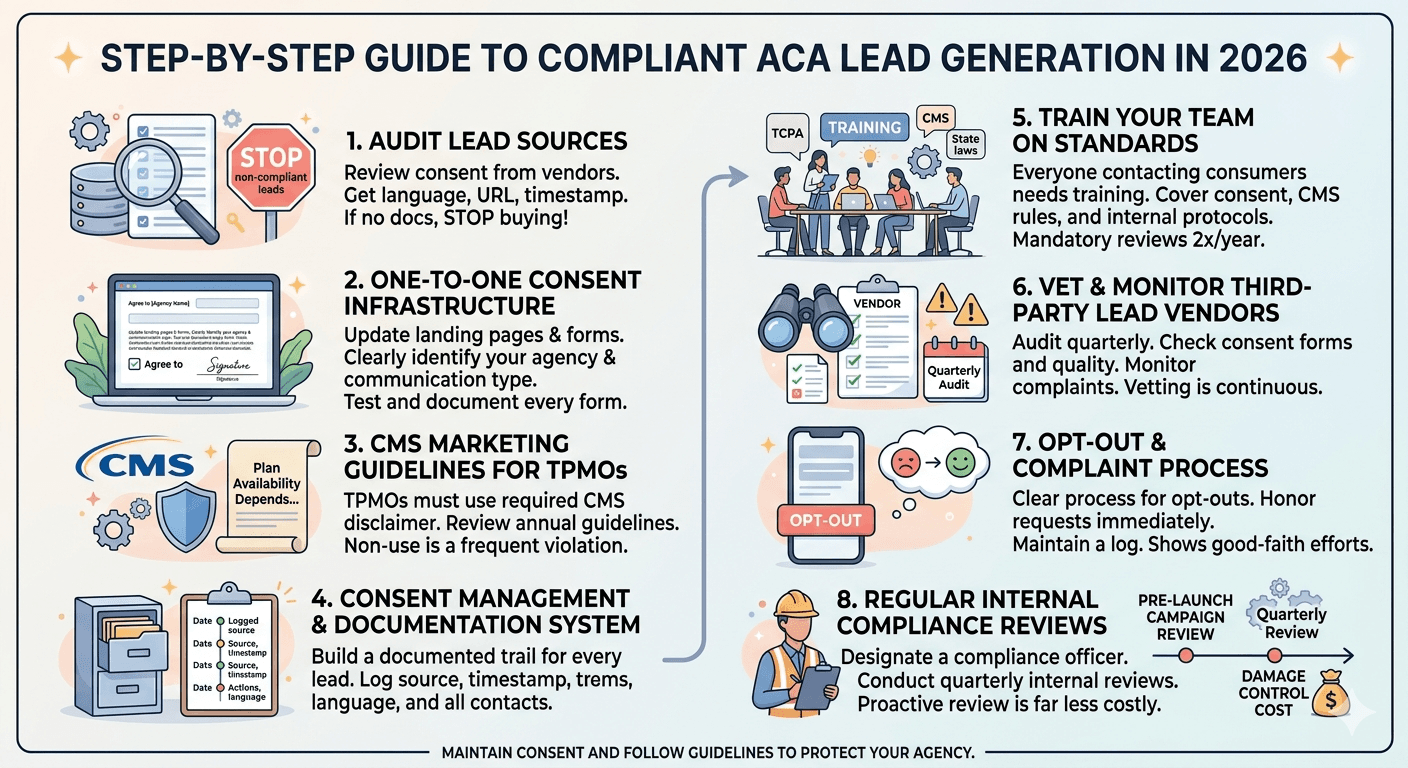
Step-by-Step Guide to Compliant ACA Lead Generation in 2026
Step 1: Audit Your Current Lead Sources
Begin by reviewing every source from which you currently receive or purchase ACA leads. Ask vendors to provide their consent language, the specific URL or call flow where consent was captured, and the timestamp of the opt-in. If a vendor cannot provide this documentation, stop purchasing from them immediately. Using non-compliant leads downstream puts your compliance record at risk regardless of whether the vendor was responsible upstream.
Step 2: Implement One-to-One Consent Infrastructure
Update all of your own landing pages, web forms, and call intake scripts to capture one-to-one consent. The consent language must clearly identify your agency by name, explain that the consumer is agreeing to receive communications from your agency specifically, describe the type of communications they will receive, and include the method by which they may revoke consent. Generic language that bundles consent for multiple companies is no longer compliant under the FCC’s updated rules. Every form must be tested and documented before going live.
Step 3: Register and Follow CMS Marketing Guidelines for TPMOs
If your agency qualifies as a TPMO under CMS definitions (which applies to most independent agents and FMOs), you must use the required disclaimer in all marketing materials. The disclaimer states that the agent represents multiple carriers and that enrollment depends on plan availability. Review the CMS marketing guidelines annually, as they are updated with each plan year. Non-use of required disclaimers is one of the most frequently cited compliance violations in CMS audits.
Step 4: Build a Consent Management and Documentation System
Every lead your agency touches must have a documented consent trail. Use a CRM or dedicated consent management platform to log the source of the lead, the consent timestamp, the language that was agreed to, and all subsequent contact attempts. This documentation is your first line of defense in any compliance investigation or TCPA lawsuit. Without it, you cannot demonstrate that your outreach was lawful.
Step 5: Train Your Team on Compliance Standards
Compliance is not a one-person job. Every person in your agency who contacts consumers, handles data, or creates marketing materials needs regular training. Training should cover TCPA consent rules, CMS marketing guidelines, state-specific requirements in your licensed markets, and your internal protocols for documenting and escalating potential violations. Create a compliance calendar that schedules mandatory reviews at least twice per year.
Step 6: Vet and Monitor Third-Party Lead Vendors Continuously
Vendor vetting is not a one-time exercise. Even vendors who provided clean documentation when you first signed with them can drift into non-compliant practices. Audit vendors on a quarterly basis. Review their consent forms, check for any recent FTC or state attorney general actions, and monitor the quality and behavior of the leads they send. If consumer complaints start rising from a particular vendor’s leads, investigate immediately.
Step 7: Establish a Consumer Opt-Out and Complaint Process
Your compliance framework must include a clear and functional process for consumers to opt out of communications and to file complaints. Opt-out requests must be honored promptly, and the consumer’s record must be suppressed across all contact channels. Keep a log of all opt-out requests and complaints. Regulators view an accessible and responsive complaint process as evidence of good-faith compliance efforts.
Step 8: Conduct Regular Internal Compliance Reviews
Designate a compliance officer or assign compliance oversight responsibilities to a specific team member. This person should conduct quarterly reviews of your lead generation processes, marketing materials, consent documentation, and vendor relationships. Any changes to your campaigns should be reviewed through a compliance lens before launch. Proactive internal review is far less costly than reactive damage control.
Common ACA Lead Generation Compliance Mistakes Agents Should Avoid
Even agencies that make compliance a priority can unintentionally create risks through small mistakes that seem harmless at first. In today’s highly regulated ACA environment, minor oversights can quickly develop into costly compliance violations if they become part of everyday business operations.
Do not assume every purchased lead is automatically compliant.
- Every agency shares responsibility for verifying how consumer consent was collected, regardless of where the lead originated
- Before contacting any prospect, confirm that proper consent documentation exists and that the consumer specifically agreed to receive communications from your agency
Keep organized, accurate consent records.
- Many agencies collect consent correctly but fail to store timestamps, consent language, or source documentation in an organized manner
- If regulators or carriers request proof during a compliance audit, missing documentation can be just as problematic as never obtaining consent at all
Avoid exaggerated or misleading marketing language.
- Promises such as guaranteed savings or best ACA plan without proper context may violate marketing guidelines and damage consumer trust
- Communications should focus on factual information and educational content that helps consumers make informed decisions while supporting overall compliance
Respond quickly to opt-out requests.
- When someone asks to stop receiving calls, emails, or texts, agencies must act quickly to remove them from future campaigns
- Continuing communication after an opt-out request creates significant TCPA exposure and undermines your compliance efforts
Standardize procedures across every team.
- Marketing, sales, customer service, and compliance staff should all follow the same documented procedures to ensure consistent handling of consumer information
- Without standardized processes, employees may unknowingly follow different rules, increasing the likelihood of compliance violations
Invest in regular training.
- Regulations continue to evolve, and employees who were fully compliant last year may unknowingly use outdated practices today
- Scheduling routine training sessions helps everyone stay informed about current CMS guidance, consent requirements, and internal compliance policies
Review automation with human oversight.
- Automated CRM workflows, email campaigns, and SMS sequences improve efficiency, but should always be reviewed to ensure they respect consumer consent and regulatory requirements
- Periodic audits of automation systems can catch compliance issues before they grow into larger concerns
Treat compliance as an ongoing strategy, not a one-time task.
- Every new marketing campaign, advertising platform, or lead vendor should be reviewed through a compliance lens before implementation
- Building this culture of accountability protects your agency from risk while strengthening consumer confidence and establishing your business as a trusted source of ACA guidance in 2026 and beyond
Compliance Tools and Resources for 2026
Several technology platforms have emerged specifically to support ACA lead generation compliance. Consent management systems such as ActiveProspect’s TrustedForm and Jornaya’s LeadiD allow you to capture tamper-proof documentation of consumer consent in real time. These tools are increasingly expected by carriers and regulators as evidence of compliant lead handling.
CMS publishes updated marketing guidelines each fall ahead of Open Enrollment. Bookmark the CMS website and subscribe to HPMS memos if your agency operates at scale. State insurance commissioners also publish bulletins that can affect your compliance obligations in specific markets.
Benefits of Staying Compliant
When you follow ACA compliance rules, you’ll actually see some big advantages:
- Protect Your Business: Avoid fines, penalties, or legal issues.
- Build Trust: Clients feel safer sharing sensitive information.
- Better Lead Quality: Compliant leads are often more engaged and easier to convert.
- Strong Reputation: Ethical marketing builds credibility and repeat business.
- CMS Peace of Mind: Staying compliant makes audits and reviews stress-free.
Drawbacks and Challenges
No system is perfect, and compliance does come with a few challenges:
- Slower Lead Generation: Extra rules can slow down how quickly you collect leads.
- Higher Costs: Secure systems and verified lead sources can be expensive.
- Complex Rules: CMS regulations change often, which can feel overwhelming.
- Limited Aggressive Marketing: Certain tactics are off-limits, which may limit outreach options.
FAQs About ACA Lead Compliance
Q1: Can I buy ACA leads from any provider?
A1: Only from providers who follow compliance rules. Verify that the leads were collected ethically and with consent.
Q2: Do I need consent to call leads from my own website?
A2: Yes. Even if they fill out a form on your site, make sure you clearly explain how their information will be used.
Q3: What happens if I break the rules?
A3: Violations can lead to fines, penalties, or even legal action from clients.
Q4: Can social media leads be compliant?
A4: Absolutely but only if you’re transparent, get consent, and protect their data.
Q5: How often do these rules change?
A5: CMS updates guidance frequently, sometimes every year. Stay informed to avoid mistakes.
Conclusion
ACA lead generation in 2026 demands that every agent treat compliance as a core operating principle rather than a regulatory inconvenience. The landscape has changed substantially, and the agents who will succeed are those who build their entire acquisition funnel around consent, transparency, and accountability. Compliance protects your consumers, your contracts, your license, and your long-term revenue. By following the steps outlined in this guide, investing in the right tools, and making compliance a shared responsibility across your team, you position your agency to grow with confidence through Open Enrollment and beyond.
