
Every Medicare agent has a list of leads that went cold. Prospects who showed interest, answered a question or two, and then disappeared. Most agents write those leads off and move on, spending more money to replace them with fresh contacts. But what if you did not have to? What if you could re-engage those lost prospects at a fraction of the cost of acquiring new ones? That is exactly what a smart medicare lead retargeting strategy makes possible.
Retargeting is one of the most cost-effective tools available to Medicare agents today, and most agents are either not using it at all or using it wrong. This guide breaks down how to build a medicare lead retargeting strategy that brings cold prospects back into your pipeline and lowers your overall cost per enrollment in the process.
What Is a Medicare Lead Retargeting Strategy and Why Does It Matter?
Before we get into the how, let us get clear on the what. A medicare lead retargeting strategy is a system for re-engaging prospects who have previously interacted with your brand but did not convert. This could mean someone who visited your website, clicked on an ad, filled out a form, answered your call once, or even started an enrollment and dropped off before completing it.
Retargeting works because it keeps you in front of people who already know who you are. Unlike cold outreach where you are introducing yourself from scratch, a medicare lead retargeting strategy starts with a warm foundation. The prospect has already raised their hand once. Your job is to give them a reason to raise it again.
The numbers make a strong case. Retargeted prospects convert at significantly higher rates than cold leads, and the cost to re-engage them is typically much lower than acquiring a brand new contact. For Medicare agents working with tight marketing budgets and high cost per acquisition, a well-executed medicare lead retargeting strategy can be a genuine game changer.
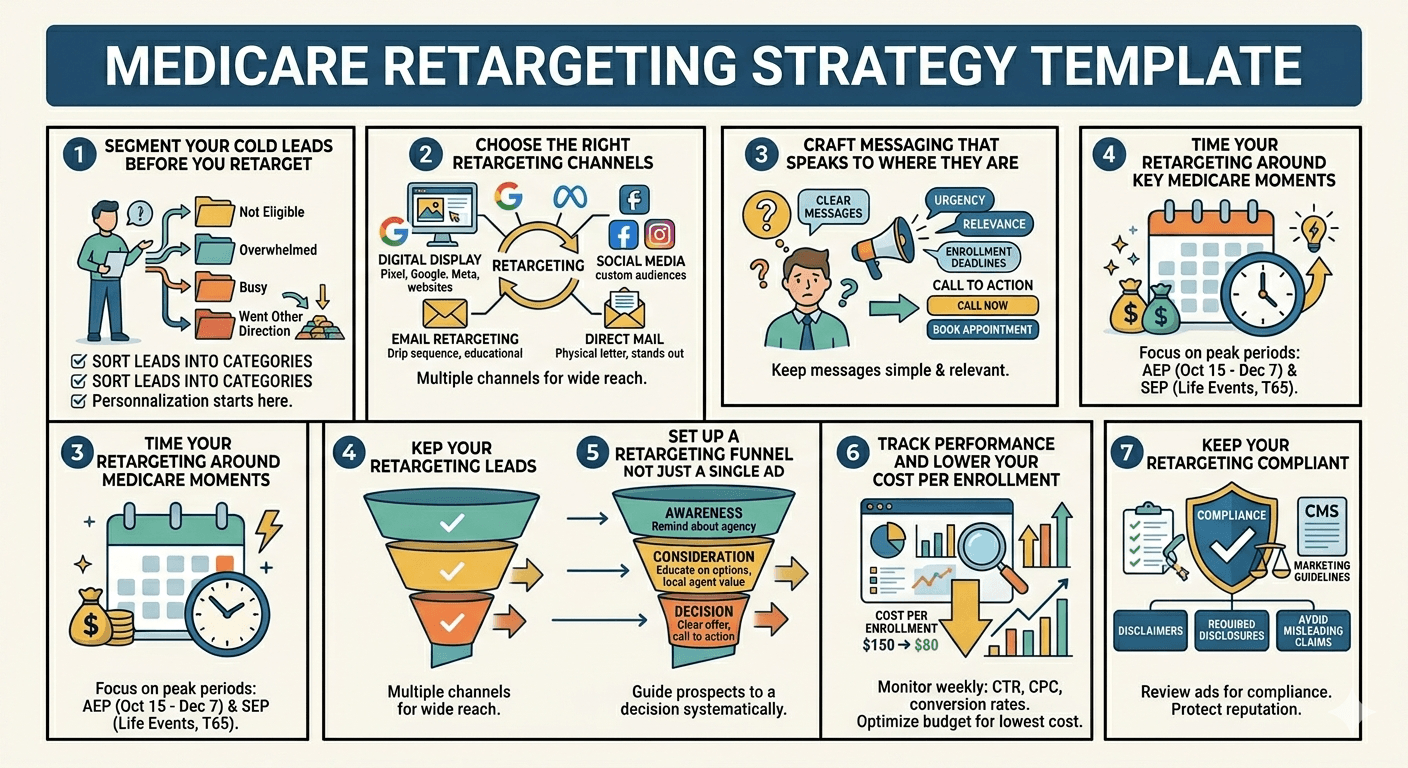
Step 1: Segment Your Cold Leads Before You Retarget
The first step in any effective medicare lead retargeting strategy is segmentation. Not every cold lead went cold for the same reason, and not every cold lead deserves the same approach when you re-engage them.
Start by sorting your cold leads into categories. Some prospects went cold because the timing was not right. Maybe they were not yet eligible for Medicare or were still covered under an employer plan. Others dropped off because they felt overwhelmed by the options. Some simply got busy and forgot to follow up. And a small percentage decided to go a different direction entirely.
Each of these segments needs a different message and a different approach. A medicare lead retargeting strategy that sends the same generic message to every cold contact is going to underperform every time. Personalization is what makes retargeting work, and personalization starts with segmentation.
Step 2: Choose the Right Retargeting Channels
A successful medicare lead retargeting strategy uses multiple channels to reach prospects where they already spend their time. Relying on a single channel limits your reach and reduces the effectiveness of your efforts.
- Digital Display Retargeting: If you are running a website, install a retargeting pixel from platforms like Google or Meta. This allows you to serve display ads to anyone who has visited your site but did not convert. These ads keep your agency visible as prospects browse other websites, gently reminding them that you are available when they are ready to take the next step. Digital display retargeting is a core component of any modern medicare lead retargeting strategy.
- Social Media Retargeting: Facebook and Instagram offer powerful retargeting tools that let you upload your existing lead list and serve ads directly to those contacts. You can create custom audiences from your CRM data and target them with Medicare-specific messaging during open enrollment and special enrollment periods. Social media retargeting is particularly effective for reaching the growing number of Medicare-eligible seniors who are active on these platforms.
- Email Retargeting: Do not overlook email as part of your medicare lead retargeting strategy. A well-crafted drip email sequence can re-engage cold leads over time with educational content, deadline reminders, and personalized plan comparisons. Email retargeting is low cost and highly scalable, making it an essential channel in your overall approach.
- Direct Mail Retargeting: For the Medicare demographic, direct mail still carries significant weight. Consider sending a physical mailer to prospects who have gone cold after initial digital or phone contact. A tangible piece of mail can stand out in a way that another email or ad simply cannot. Adding direct mail to your medicare lead retargeting strategy gives you a multi-channel presence that reinforces your message across different formats.
Step 3: Craft Messaging That Speaks to Where They Are
The messaging in your medicare lead retargeting strategy needs to be different from your initial outreach. These prospects already heard your general pitch. What they need now is something that speaks more specifically to their hesitation or their current situation.
Focus on urgency and relevance. Remind them of upcoming enrollment deadlines. Highlight changes to Medicare plans for the current year that could affect their coverage. Share a simple comparison of what staying uninsured or underinsured actually costs versus enrolling in a plan that fits their budget.
Keep the message simple and the call to action clear. A confused prospect does nothing. Your medicare lead retargeting strategy should make it absolutely obvious what you want them to do next, whether that is calling a number, booking an appointment, or clicking a link to get a free plan comparison.
Step 4: Time Your Retargeting Around Key Medicare Moments
Timing is one of the most powerful levers in a medicare lead retargeting strategy. The Medicare calendar creates natural windows of urgency that you can use to your advantage.
The Annual Enrollment Period from October 15 to December 7 is the most critical time to activate your retargeting efforts. During this window, prospects who went cold months ago suddenly have a real reason to make a decision. Ramp up your retargeting spend and frequency during AEP and make sure your messaging reflects the deadline-driven nature of the period.
Special Enrollment Periods triggered by life events like losing employer coverage, moving, or turning 65 are also prime moments for a medicare lead retargeting strategy. If you know a prospect is approaching their 65th birthday or recently had a qualifying life event, that is a perfect trigger to re-engage them with timely, relevant messaging.
Step 5: Set Up a Retargeting Funnel Not Just a Single Ad
One of the most common mistakes agents make with retargeting is treating it as a single touchpoint rather than a funnel. A truly effective medicare lead retargeting strategy guides the prospect through a sequence of touchpoints that progressively move them toward a decision.
Start with awareness-level retargeting that simply reminds them of your agency and what you offer. Follow that with consideration-level content that educates them on their Medicare options and the value of working with a local agent. Then move into decision-level retargeting with a clear offer, a specific call to action, and a strong reason to act now.
Each stage of your medicare lead retargeting strategy funnel should have its own message, its own creative, and its own goal. Moving prospects through this sequence systematically is what separates high-performing retargeting campaigns from ones that simply show the same ad over and over with diminishing returns.
Step 6: Building a Multi-Touch Follow-Up System That Re-Engages Medicare Leads
A successful medicare lead retargeting strategy goes far beyond running a single ad or sending one follow-up email. Prospects often need multiple interactions before they feel comfortable making an enrollment decision, especially when that decision affects their healthcare and finances.
One Channel Is Never Enough
- Relying on a single communication method leaves significant enrollment opportunities on the table
- Combine email, text messaging, phone calls, educational content, and remarketing ads into one coordinated sequence
- Each touchpoint should deliver new value rather than repeating the same sales message your prospect already ignored
Build a Sequence That Guides Prospects Step by Step
- When a prospect visits your website but leaves without requesting a consultation your medicare lead retargeting strategy should immediately trigger a structured response
- Start with a retargeting ad highlighting Medicare enrollment deadlines
- Follow a few days later with an educational email explaining common plan options and answering frequently asked questions
- Then send a personalized text message inviting them to schedule a free consultation
- Finally have an agent make a friendly follow-up call if there is still no response
- Each step builds familiarity and demonstrates that your agency is focused on helping rather than just selling
Time Your Communications Strategically
- Space messages carefully so prospects stay engaged without feeling overwhelmed or pressured
- During the Annual Enrollment Period shorten intervals between touchpoints because deadlines create natural urgency
- Outside enrollment periods extend your timeline and shift focus toward education, Medicare updates, and helpful resources that keep your agency top of mind year round
- Timing is one of the most underestimated elements of any effective medicare lead retargeting strategy
Personalization Dramatically Improves Engagement
- Use information from previous interactions such as age, current coverage, preferred communication method, and specific Medicare interests to tailor every message
- Someone researching Medicare Advantage plans should receive completely different content than a prospect exploring Medicare Supplement coverage for the first time
- Modern CRM platforms and marketing automation tools can trigger customized sequences based on user behavior without requiring manual effort from your team
Monitor Engagement Metrics Throughout the Sequence
- Track email open rates, ad click-through rates, landing page visits, text responses, and scheduled appointments consistently
- Identify exactly where prospects are dropping off and adjust your messaging or timing at those specific points
- Data collected during your medicare lead retargeting campaigns reveals improvement opportunities that assumptions never could
The Real Goal Is Presence Not Pressure
- The most successful Medicare agencies understand that consistent follow-up is about staying visible, answering questions, and reducing uncertainty until prospects are genuinely ready to enroll
- Increasing the number of sales pitches rarely improves results but increasing the value of each touchpoint almost always does
- A well-executed medicare lead retargeting strategy recovers lost opportunities, strengthens relationships, improves conversion rates, and maximizes the return on every lead already sitting in your database
Step 7: Track Performance and Lower Your Cost Per Enrollment
A medicare lead retargeting strategy is only as good as the data behind it. Tracking your results at every stage of the funnel is what allows you to optimize your spend and continuously lower your cost per enrollment.
Monitor your retargeting ad performance weekly. Look at click-through rates, cost per click, and conversion rates by audience segment and by channel. Identify which segments are responding best and shift your budget toward those audiences. Identify which channels are delivering the lowest cost per re-engagement and prioritize them in your overall medicare lead retargeting strategy.
Compare your cost per enrollment from retargeted leads versus cold leads. In most cases, you will find that retargeted leads convert at a significantly lower cost. That data becomes your business case for investing more in retargeting and less in constantly chasing brand new cold contacts.
Step 8: Keep Your Retargeting Compliant
Medicare marketing is governed by strict CMS regulations, and your medicare lead retargeting strategy must operate within those boundaries. Any ad or communication you send to Medicare-eligible prospects must comply with CMS marketing guidelines, including rules around disclaimers, prohibited language, and required disclosures.
Make sure any digital ads you run as part of your medicare lead retargeting strategy are reviewed for compliance before they go live. Avoid making specific benefit claims that could be considered misleading. Work with your FMO or compliance team to ensure your retargeting content meets all applicable standards. A compliance issue can not only damage your reputation but also put your license at risk.
Use Suppression Lists to Protect Your Retargeting Budget
Knowing who to retarget is only half the job. A smart medicare lead retargeting strategy also knows who to leave out. Without exclusions, you can waste money showing ads to people who no longer need them.
Start by removing clients who have already enrolled. Few things feel more irritating to a new client than seeing “Compare Medicare Plans” ads weeks after signing with you. It also burns budget on people who cannot convert again this season.
Next, add anyone who asked to stop receiving messages. Upload your opt-out list to Google and Meta as an excluded audience so those contacts never see your ads. This protects your compliance record and shows respect for the people you serve.
You should also exclude leads that your team has marked as unqualified, such as contacts who are not yet eligible or who already work with another agent. Retargeting them rarely pays off.
Update your suppression lists weekly, especially during the Annual Enrollment Period, when enrollments happen fast. Your CRM can sync these lists automatically.
Over time, clean exclusions lower wasted spend and keep your medicare lead retargeting strategy focused on prospects who are still open to a conversation.
Frequently Asked Questions
Q1. What is a medicare lead retargeting strategy?
A1. It is a system that re-engages cold prospects using ads, emails, and direct mail — bringing them back into your pipeline at a much lower cost than buying new leads.
Q2. How much does Medicare lead retargeting cost?
A2. Digital retargeting can start with just a few dollars a day. Overall it costs far less per conversion than chasing cold contacts from scratch.
Q3. Is retargeting compliant with CMS Medicare marketing rules?
A3. Yes, as long as your content meets CMS guidelines. Always check for required disclosures and prohibited language before any retargeting ad goes live.
Q4. How long should I retarget a cold Medicare lead?
A4. Stick to a 30 to 90 day window. After that, most prospects who have not responded will need a completely different approach to re-engage.
Q5. Which retargeting channel works best for Medicare leads?
A5. A mix always wins. Digital and social for scale, email and direct mail for personalization. Multi-channel always outperforms going all in on just one.
Conclusion
A well-built medicare lead retargeting strategy is one of the smartest investments a Medicare agent can make. Instead of constantly paying for new leads to replace the ones that went cold, retargeting lets you squeeze far more value out of the prospects already in your pipeline.
From segmenting your cold leads and choosing the right channels to crafting the right message at the right time, every element of your medicare lead retargeting strategy works together to bring more prospects back into your funnel and lower your cost per enrollment. The agents who master retargeting do not just close more policies. They build a more efficient, more profitable Medicare business that keeps growing season after season.
