You just got pinged with a fresh ACA lead. Name, phone number, email everything looks good. You make a mental note to call them after lunch. But by the time you dial, they’ve already enrolled with another agent. Sound familiar?
If you’re losing enrollments because your ACA lead follow up process isn’t fast enough, you’re leaving serious money on the table. The difference between contacting a lead in 5 minutes versus 5 hours can be the difference between a commission and a lost opportunity. In this guide, I’m going to show you exactly how to build an ACA lead follow up process that gets results before your competition even picks up the phone.
What Is the ACA Lead Follow Up Process?
Let’s start with the basics. An ACA lead follow up process is the systematic approach agents use to contact, qualify, and enroll health insurance leads from the moment they express interest until they either enroll or explicitly opt out.
But here’s what makes ACA leads different from other insurance leads: they decay faster. Much faster.
When someone submits their information looking for ACA coverage, they’re not just casually browsing. They’re actively shopping, often comparing multiple agents simultaneously. They might have three agents calling them within the first hour. The agent who contacts them first and provides value immediately usually wins the enrollment.
Speed directly impacts your enrollment rates. Industry data consistently shows that agents who contact leads within the first 5 minutes have conversion rates 400% higher than those who wait even an hour. That’s not a typo. Your ACA lead follow up process needs to prioritize speed above almost everything else.
Why ACA Leads Expire Before Agents Contact Them
Let me paint you a picture of what’s happening on the consumer side. Someone fills out an ACA lead form at 2:47 PM. By 2:50 PM, they’ve received three phone calls. By 3:15 PM, they’ve already had a conversation with an agent who answered their questions and started the enrollment process.
If you’re the fourth agent calling at 4:30 PM, you’re too late. The lead has already expired not because the person isn’t interested anymore, but because someone else got there first.
Here are the main reasons ACA leads expire before agents can contact them:
- Multiple Agents Competing: Most ACA leads are sold to multiple agents simultaneously. You’re not the only one with that phone number. The first person to provide value wins.
- Consumer Shopping Behavior: People researching ACA plans are often in “decision mode.” They want answers now, not tomorrow. If you’re not available immediately, they’ll move on to someone who is.
- Marketplace Time Sensitivity: Open Enrollment has hard deadlines. Special Enrollment Periods expire. When someone is actively looking for coverage, there’s urgency built into the situation. Your ACA lead follow up process needs to match that urgency.
- SEP Expiration Windows: If someone qualifies for a Special Enrollment Period, they typically have 60 days to enroll. But they don’t know that. In their mind, they need coverage NOW. The agent who responds immediately captures that momentum.
The bottom line? ACA leads don’t wait around. Your follow up process can’t either.
How Fast ACA Agents Should Follow Up on Leads
Alright, let’s get specific. How fast is fast enough?
First Contact Window: You should be attempting first contact within 5 minutes of receiving the lead. Yes, 5 minutes. I know that sounds aggressive, but it’s necessary. Leads contacted within 5 minutes are 21 times more likely to convert than leads contacted after 30 minutes.
If you can’t reach them in the first attempt (and you often won’t most people don’t answer unknown numbers), here’s your follow-up cadence:
Day 1 (First Hour):
- Attempt 1: Immediate call (0-5 minutes)
- Attempt 2: Text message with introduction (5-10 minutes)
- Attempt 3: Follow-up call (30-60 minutes later)
Day 1 (Later):
- Attempt 4: Email with helpful resources (2-3 hours after first contact)
- Attempt 5: Final call of the day (evening, 5-7 PM)
Day 2-3:
- Morning call or text
- Afternoon follow-up
Day 7:
- Check-in message
- Offer specific value (calculator, plan comparison, etc.)
Day 14:
- Final attempt
When to Stop: After 7-10 attempts over 14 days, it’s time to move on. Document the lead as “unresponsive” and focus your energy on fresh opportunities.
Here’s a simple timeline table:
| Timeframe | Action | Method |
| 0-5 minutes | First contact | Call |
| 5-10 minutes | Introduction | Text |
| 30-60 minutes | Second attempt | Call |
| 2-3 hours | Resources sent | |
| Same evening | Third attempt | Call |
| Day 2 | Morning follow-up | Call/Text |
| Day 3 | Check-in | Call |
| Day 7 | Value offer | Text/Email |
| Day 14 | Final attempt | Call |
Ideal ACA Lead Follow Up Timeline (Agent Workflow)
Let me break down the ideal workflow step-by-step so you can implement this immediately:
- 0-5 Minutes: First Call/Text: The moment you receive a lead notification, drop what you’re doing and call. Have your script ready to increase your respond time. If they don’t answer (and they probably won’t), leave a 15-second voicemail mentioning you’re returning their inquiry about health insurance. Immediately follow with a text introducing yourself.
- Same Day: Second Attempt: Wait 30-60 minutes, then try again. Different times of day yield different results. If you called at 2 PM and got voicemail, try again at 6 PM when they might be off work.
- Day 2-3: Reminder Cadence: Send a text in the morning: “Hi [Name], still hoping to connect about your health insurance options. What’s a good time to talk today?”
- Call again in the afternoon. Vary your approach maybe this time you open with a specific question about their coverage needs based on information from their lead form.
- Day 7+: Final Attempts: By now, you’ve tried multiple times. Your day-7 message should offer something specific and valuable: “Hi [Name], I put together a quick comparison of the top 3 plans for your ZIP code and budget. Want me to send it over?”
This is your last real shot. Make it count.
A well-structured ACA lead follow up process removes the guesswork. You’re not wondering “should I call again?” You’re following a system that tells you exactly what to do and when.
Common ACA Lead Follow Up Mistakes
I’ve watched countless agents sabotage their own success with these mistakes. Learn from them:
- Waiting Until “Later” This is the kiss of death. “I’ll call during my lunch break” means you’ve already lost the lead. Successful agents treat every new lead like an emergency. Because in terms of conversion rates, it basically is.
- No Reminders You’re busy. You forget. It happens. But relying on your memory is a terrible ACA lead follow up process. If you don’t have automatic reminders firing, you’re going to drop leads. It’s not a question of if, it’s when.
- Poor Documentation You called three times but forgot to log it in your CRM. Now you can’t remember if this is lead #347 or #348, when you last contacted them, or what you discussed. Without documentation, you’re flying blind.
- Giving Up Too Early One voicemail and done? That’s not a follow-up process, that’s a lazy attempt. Most enrollments happen after the 4th or 5th contact attempt. If you’re quitting after one or two tries, you’re leaving 60-70% of your potential commissions on the table.
- Following Up Too Aggressively There’s a balance. Seven calls in one hour is harassment, not persistence. Space out your attempts. Provide value with each contact. Your goal is to be helpful, not annoying.
Manual vs Automated ACA Lead Follow Up
Let’s talk about how agents actually manage their ACA lead follow up process. There are basically four approaches:
- Memory + Sticky Notes This is where most new agents start. You write the lead info on a sticky note, stick it on your monitor, and hope you remember to call. Spoiler alert: this doesn’t scale. Once you’re getting 10+ leads per day, you’ll lose track.
- CRMs Customer Relationship Management systems are better. You can log contacts, set reminders, and track your pipeline. The problem? Most CRMs aren’t built specifically for the ACA lead follow-up process. They’re generic sales tools that require heavy customization.
- Spreadsheets I know agents running six-figure ACA businesses entirely from Google Sheets. It works, but it’s manual labor. You have to constantly update timestamps, calculate follow-up times, and check your sheet throughout the day. One missed row and you’ve lost a lead.
- Follow Up Timers & Reminders Built for ACA This is where specialized tools shine. Software built specifically for ACA agents understands the follow-up cadence you need. Timer starts automatically when a lead arrives. Reminders fire at optimal intervals. Status updates get logged without you thinking about it.
The difference between a manual ACA lead follow up process and an automated one is like the difference between hand-washing dishes and having a dishwasher. Both get the job done, but one lets you focus on higher-value activities like actually talking to leads instead of managing spreadsheets.
How to Build a Repeatable ACA Lead Follow Up System
You need a system, not a series of random actions. Here’s how to build one:
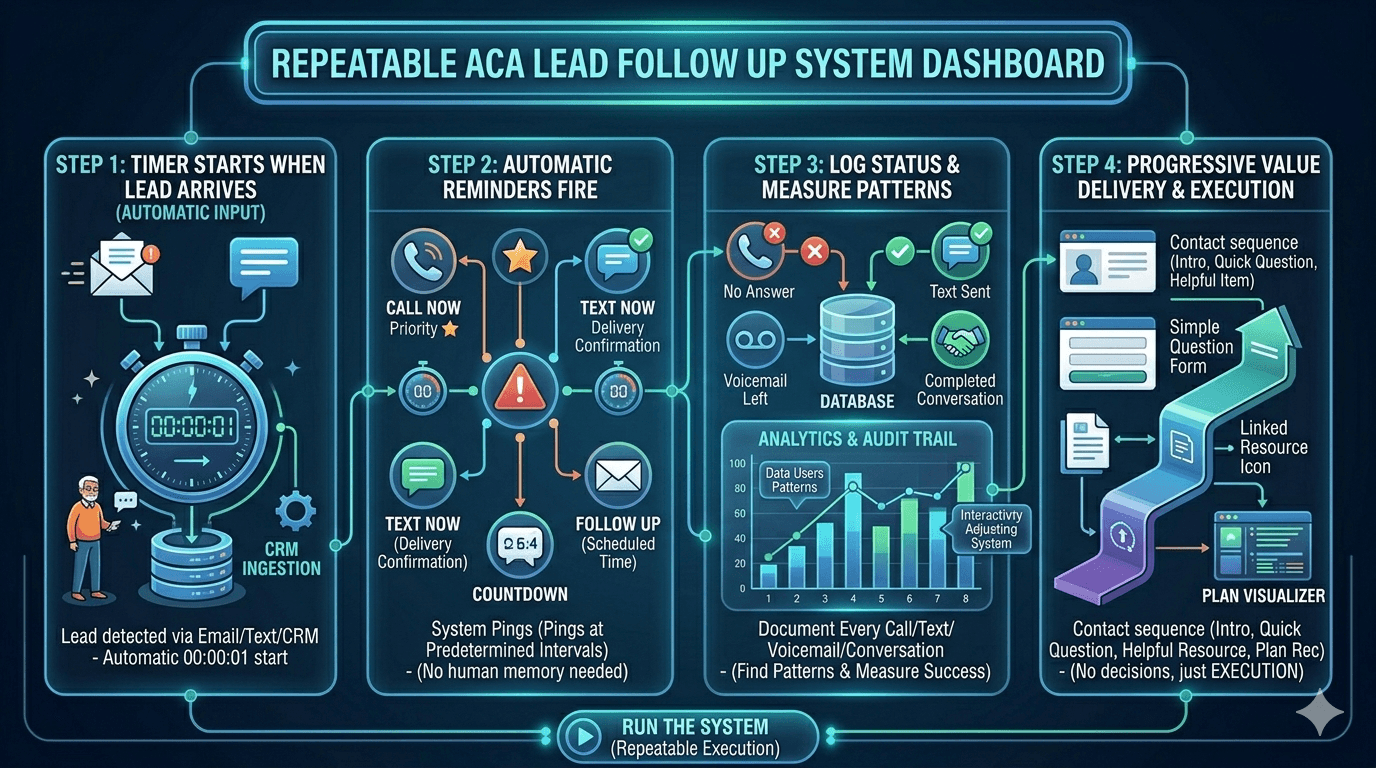
Step 1: Timer Starts When Lead Arrives The moment a lead enters your system whether that’s via email, text, or CRM the clock starts ticking. This should be automatic, not manual. If you’re starting the timer yourself, you’ve already lost 2-3 minutes.
Step 2: Automatic Reminders Fire Your system should ping you at predetermined intervals. “Call now.” “Text now.” “Follow up.” You’re not relying on your brain to remember. The system tells you exactly what to do next.
Step 3: Lead Status Updates Get Logged Every call attempt, text sent, voicemail left, and conversation completed gets documented. This creates an audit trail and lets you see patterns. Which follow-up attempts have the highest answer rates? What messaging works best? You can’t improve what you don’t measure.
Step 4: Progressive Value Delivery Each contact in your ACA lead follow up process should offer something useful. First call: introduction. Second attempt: quick question about their needs. Third: link to a helpful resource. Fourth: specific plan recommendation. You’re building relationship equity with every touch point.
This framework works because it’s repeatable. New lead comes in? Run the system. No decisions, no hesitation, just execution.
Why Personalization Is the Secret to a High-Converting ACA Lead Follow Up Process
A structured workflow is essential, but one factor often separates top-performing agents from everyone else: personalization. Many agents treat every prospect the same, sending identical texts, repeating the same phone script, and following a generic email sequence regardless of the person’s situation. While automation saves time, a strong ACA Lead Follow Up Process depends on personalization to build the trust that ultimately drives enrollments. Combining speed with relevance ensures every interaction feels genuine rather than automated.
Combine speed with relevance.
- Before your first call, review the lead form for context, such as losing employer coverage, moving, getting married, or expecting a child
- Acknowledging their specific situation naturally builds credibility and leads to a more productive conversation
- Even small details, like mentioning their city or confirming their preferred contact method, make the interaction feel more personal and human
Personalize texts and emails, not just calls.
- Avoid generic messages like “Just checking in”
- Share useful information such as Special Enrollment eligibility, how premium tax credits work, or plan comparisons for their ZIP code
- Every step in the ACA Lead Follow Up Process should answer a question or reduce confusion rather than just ask if they’re still interested
- Useful, relevant messages are far more likely to get a response than repetitive check-ins
Match communication to each prospect’s preferences.
- Some consumers prefer quick texts during work hours, while others prefer phone calls in the evening
- Recognizing these preferences shows professionalism and increases response rates within your follow up efforts
- Paying attention to how someone likes to communicate builds trust faster than sticking to a rigid script
Adjust messaging based on the decision stage.
- A new inquiry may need basic ACA education, while a prospect who’s already spoken with other agents may just need clarity on networks, deductibles, or premiums
- Delivering the right information at the right time keeps a well-run ACA Lead Follow Up Process moving toward enrollment without pressure
- Understanding where a prospect stands helps you avoid repeating information they already know, which keeps conversations efficient and respectful
Think beyond the immediate sale.
- Even if someone doesn’t enroll right away, occasional value-driven communication throughout the year keeps you top of mind
- This positions you as their trusted advisor when a Special Enrollment Period arises or the next Open Enrollment begins
- Over time, these relationships generate referrals, repeat business, and stronger customer loyalty
- A thoughtful, long-term ACA Lead Follow Up Process often produces more enrollments over time than aggressive short-term pressure
Remember what prospects actually recall.
- Consumers don’t remember how many times you reached out, they remember how helpful, knowledgeable, and respectful you were throughout the experience
- Building a reputation for genuine helpfulness leads to stronger word-of-mouth referrals within your community
By combining automation with meaningful personalization, your ACA Lead Follow Up Process becomes more than a sequence of reminders. It becomes a relationship-building system that consistently increases response rates, improves customer satisfaction, and produces more enrollments, setting you apart from competitors who rely solely on generic follow-up messages.
Tools That Help ACA Agents Follow Up Faster
Let’s talk about the actual tools and tactics that make a fast ACA lead follow up process possible:
- Text vs Call: Both are necessary. Calls build rapport and allow detailed conversations. Texts have higher open rates and are less intrusive. Your ideal process uses both strategically. Call first, text immediately after if no answer, then alternate based on lead response patterns.
- Reminder Systems: At minimum, use your phone’s native reminders or calendar alerts. Better: use a CRM with task management. Best: use purpose-built ACA follow up software that handles reminders automatically based on your predetermined cadence.
- Compliance-Safe Messaging: Remember TCPA rules. You need proper consent to text or call. Make sure your lead source provides compliant opt-ins. Never text leads who haven’t agreed to receive texts it’s not just bad practice, it’s illegal.
- Dedicated ACA Lead Follow Up Tools: Generic sales tools work, but they’re not optimized for the unique rhythm of ACA leads. Tools built specifically for ACA agents understand Open Enrollment seasonality, SEP qualification timelines, and the aggressive follow-up cadence the industry requires.
The right tools don’t just make you faster they make your ACA lead follow up process more effective. You’re not just doing more, you’re doing it better.
Take Control of Your ACA Lead Follow Up Process
Here’s the truth: you can’t control leads in mass , but you can absolutely control how quickly and effectively you follow up on them. The agents making six figures in this industry aren’t getting magic leads they’re working the same leads as everyone else. They’re just faster and more systematic about it.
Your ACA lead follow up process is the difference between a good month and a great month. It’s the difference between scrambling to hit your goals and consistently exceeding them.
If your current system is “I’ll try to call them today,” you don’t have a system you have hope. And hope isn’t a strategy.
Build a repeatable process. Implement automatic reminders. Document everything. Follow up fast and follow up often. The leads are already coming in. Don’t waste them by being slow.
Ready to stop losing leads to faster agents? If your ACA leads are expiring before you contact them, download our proven follow-up timeline template, or try our lead follow up timer software built specifically for ACA agents. Your next enrollment is waiting you just need to be first to the phone.
ACA Lead Follow Up FAQ
Q1. How long do ACA leads stay “fresh”?
A1. Realistically, you have about 15-30 minutes of peak freshness. After that, the lead has likely been contacted by multiple agents. After 24 hours without contact, conversion rates drop by 60% or more. Speed is everything.
Q2. Is texting ACA leads allowed?
A2. Yes, if you have proper consent. Make sure your lead source includes a TCPA-compliant consent clause for text messaging. Always include your name and company in the first text, and provide an opt-out option.
Q3. How many follow ups is too many?
A3. The general rule: 7-10 attempts over 14 days. If someone hasn’t responded after that, they’re either not interested or they’ve already enrolled elsewhere. Continuing beyond that point usually yields diminishing returns.
Q4. What happens if a lead expires?
A4. An “expired” lead is simply one that’s no longer responding or has enrolled with someone else. Document it in your system, move on, and focus on fresh opportunities. Don’t take it personally it’s a numbers game.
Q5. Should I follow up with leads outside of Open Enrollment?
A5. Absolutely, especially if they might qualify for a Special Enrollment Period. Job loss, marriage, moving, having a baby these life events create SEP windows. Your ACA lead follow up process should account for year-round enrollment opportunities.
Conclusion
In the ACA world, speed isn’t a nice-to-have it’s the deciding factor. Leads don’t go cold because people lose interest; they go cold because another agent showed up faster with answers and clarity. A strong ACA Lead Follow Up Process removes hesitation, guesswork, and missed opportunities by telling you exactly what to do the moment a lead comes in and every step after that. When your follow-up is fast, consistent, and value-driven, you stop chasing leads and start converting them.
At the end of the day, success comes down to systems, not luck. Agents who win aren’t working harder they’re working smarter with a repeatable ACA Lead Follow Up Process that runs every time, without fail. If you build the right workflow, use the right tools, and commit to immediate action, you won’t just keep up with the competition you’ll beat them to the enrollment.
